
Tuesday, 5 February 2013

Hey folks, this one is a little verbose and technical but it is a reply to a question posed by Canis Philos. In this discussion we were talking about faulty patterns of cognitions and it became clear that really we are talking about beliefs. This is a WIP but there are some interesting consequences of the reasoning here.

>>Do you see the belief in the existence of an 'I' as a faulty pattern then?>>

No, I see it as a faulty belief.

Firstly, lets look at this question correctly. I think the pigeonhole you are trying to impose here is very ambiguous and it is due to the way you are using the word 'pattern'. It appears that you are not stipulating what this pattern is comprised of, however, we can certainly point to a couple of ideas that may illuminate my position.

In my system there is no "I", since the word refers to nothing tangible. It is merely a pronoun that some believe has real semantic meaning, over and above its functional role in linguistics. There is no "I", we need to be crystal clear about this.

Now, from this position we can infer that a belief in something that does not exist, is simply delusion. If I hold a BELIEF "unicorns are real", is this a faulty pattern of thinking?

It is only a faulty belief. We would have to provide an independent justification of WHY the content of this pattern is faulty.

Is a belief in a self a faulty pattern? No, it is a FAULTY BELIEF for the reason being that it entails the belief in something that does not exist. We would have to provide an independent justification of WHY the content of this pattern is faulty.

Now if we extrapolate this belief and furnish our unicorn scenario with a multitude of ideas we can start to look at cognitive patterns. Let us suppose that there is a unicorn sanctuary over yonder hill, and then let us furnish this idea with meadows, unicorns shitting golden poo, a complex system of activities to keep the unicorns entertained and deluxe stables with extra comfy hay. They are friends with all sorts of pixies, elves, toadstools and there is loads of other really C00L shit there to keep them occupied.

What we have done is taken a simple object of our fancy and multiplied it in to a complex idea. Again, we will try and attribute your criteria to this. Is it a faulty pattern?

No, again it is only faulty IN SO FAR AS IT IS BELIEVED TO BE REAL.

Now, we could look at the uses of the pattern of thinking involved in the unicorn sanctuary. I could paint a picture of this unicorn sanctuary and sell it at Sotherbys auction house for £1,000,000. I could also write a best selling children's novel, or create a range of toys for Hasbro.

Would it make sense to say this pattern of the unicorn sanctuary itself is faulty?

No.

Is it coherent with reality?

Obviously not, since unicorns do not exist.

Ideas themselves, or cognitions organised in such and such a pattern are not necessarily 'faulty', even those of the extreme fancy.

What is the criterion of a faulty cognitive pattern then?

Should we follow this chain of reasoning to its end, any fair enquirer should conclude this distinction is necessarily arbitrary, and thus no chain of reasoning is sufficient to establish the validity of any such criterion.

Let us contrast the psychopath who keeps thinking about murdering someone. Is the content faulty in his thinking? We would like to say yes here, but then I ask “Upon what foundation do you establish such a judgement?”

It is clear that any attempt to impose 'faulty patterns' on to someone else is simply arbitrary, and is coloured by ones perception of societal 'norms'.

Is the psychopath's thinking coherent with reality?

To us we would want to answer no. However, the psychopath may be disposed to see everything as a threat, and thus it is his biological disposition to believe that he must act upon these thoughts.
Is his thinking flawed though?
In the given circumstances, we can only arbitrarily determine that this is faulty thinking, however, it may be determined by his biological disposition. It is apparent then, that any such endeavour to determine what faulty thinking actually is, can only be reliant on our beliefs about the world and the way "we" perceive things.

The reality is that the content of our thoughts is driven by a neural mechanism that may or may not be "faulty". To which we would then have to define a "normal" working mechanism. Thus it would be incumbent on one to demonstrate a valid chain of reasoning to define normal and it is in vain that one should attempt this.

Thus we can draw the following conclusions:
  1. Thought itself is either coherent with reality or not.
  2. Even thought that is incoherent with reality may ultimately constitute intentional states that ultimately have value to an organism.
  3. One cannot provide criteria for deciding which of these states are faulty, since it is merely arbitrary.
  4. Therefore, the only arbiter of any such content can be its coherence with reality, and we must look to the beliefs we hold about the content, rather than claim the content itself is faulty.

Thus it makes sense to say that belief in something that does not exist is faulty, therefore the belief in an "I" is a faulty belief.

But it makes no sense to say that thinking patterns, when conceived in this way, are in themselves faulty since we have no standard by which to say what is normal. The patterns that make up the self, the story, and all that it entails is simply content. Are we to say that the contents of our thoughts is faulty?

Is it a flaw that thoughts about oneself as an entity in the world arise?

No, we have no standard with which to determine whether this is the case.

Does the BELIEF in the reality of such thoughts constitute a flaw? Yes, because believing in something that does not exist is, NECESSARILY, delusion by its very definition.

Therefore, it is reasonable to conclude that patterns are faulty only in so far as they are incoherent with reality, or believed to be true. Even then, these thoughts still may provide some value to an organism, so any such attempt to provide some kind of measure of what content constitutes 'faulty' is merely subjective, and thus no objective matter of fact can be established.

However, if one can look honestly at such patterns and deem that they are not suitable for determining their life course, it is clear that they can be challenged. Only each brain knows the right course of action for its best prospects. Notice that this does not require a self in any way.

The upshot is that any attempt to determine which are faulty patterns is completely subjective but this simply becomes do you desire to use:
a) Reality as the arbiter of whether said pattern is faulty?
b) Delusion as the arbiter of whether said pattern is faulty?

The brain reading this may now attempt to use free will to make a decision...

Thursday, 17 January 2013

Having looked at our concept of identity and reduced it down to two types, we are able to look at how there are certain presumptions made when we identify things. If you remember, we got down to to either identifying with the functional role of an object, or with its matter.

We introduced the problems with the Theseus case in part I, and much subsequent philosophy of identity has been based on trying to fix these problems. If you remember, we had established that no chain of reasoning was sufficient to establish when a change in identity occurs, when we are talking about changing physical matter around. 

We also introduced the difficulties of identifying something by its functional role. I will now turn to these and introduce the quagmire we generate, and then demonstrate how the human brain has developed a clever work around to beat the limitations of this system.

So, to start us off we can ask how does our attribution of a concept work in practice?

In the Ship of Theseus example, we were applying a name to an object. This time round we are going to come from the opposite angle and see if our object is of a sufficient kind to fit the category we are imposing upon it. To keep things simple we will use a 'car' analogy. 
I have found people do mix these conceptions of identity up, particularly before they even entertain the LOOKing process, but usually it is simple to scythe the two apart upon a quick examination. What I want to show you is how to avoid making this mistake, and also a more devious yet ingenious one, that arises from the brains natural tendency to structure experience in a familiar way.

Firstly, we could try to find a point where we can remove the cars identity, to the point where we can no longer class it as a car. If I remove the battery so it cannot receive any power, intuitively we want to say it is still a car, because it simply requires that a new battery be connected to the terminals, and then it will resume its functional role. We are not particularly inclined to remove the identity of the car just because it has no battery.

Imagine you went to the garage and the mechanic replaced the battery...

Would from the moment he removed the battery, until he connected the new one mean it was not a car during this time?

To say it was not a car for this period would be very counter intuitive, and it seems safe to say that by removing a small component, it is not going to affect its identity. This is how we intuitively feel about identity.


Another example to contrast with this could be a battery drill that has multiple functions. I can change drill bits, screwdriver heads, and even put a food mixing attachment on it if I really wanted to. In these cases, it suggests that there is some kind of continuity of identity despite the physical make up being changed.

What we are saying really is that the drill itself is unchanging, it is performing its functional role by rotating the chuck. Any attachments do not constitute the drills continuing identity, although we may call it a screwdriver, or sander instead just for convenience temporarily, particularly when it is set up in a particular way.

If I am on a contract sanding down the walls say, and my drill has been configured to have a sandpaper disc on it, I will be less likely to call it a drill and would probably hear “Can I borrow your sander please mate?"
By naming it something else, we are not suggesting its identity has fundamentally changed, but we are using the role it is performing to identify it.

However, we seem to think that there is some unchanging essence about the drill, and from the sum of its parts, arises some new property which we use to identify it, such as sander, screwdriver, or even food mixer. (Try not to imagine someone mixing a cake with a drill ;)

Intuitively it seems that changing a small part of something does not consist in changing its identity. However, there is a relevant difference between the car battery and the drill cases we looked at above. In the former instance, by removing the car battery I was interfering with the cars ability to perform its functional role. 
Without the battery the car cannot start the ignition circuit, and it would be sat there until this was remedied. In the latter instance, I was adding a utensil to the drill and changing its functional role. We agreed that by addition or removal of something small we are not changing its identity but what we have done is come round full circle.

We can introduce a range of cases where we take away 1% of the parts all the way to 100% of the parts. Like the Theseus example, when we try to establish an argument about how many components we need to remove before it is no longer a car, we find that any figure is arbitrary and thus we cannot establish any chain of reasoning.

Does this still hold for the drill case though, surely we can simply swap out attachments and change its identity?

Photo by M. Quinn Sweeney


The problem is, we denied earlier that the drill changed its identity when we put different attachments on it. We still wanted to claim it was a drill that's identity was abiding throughout the transitions in to egg whisk and screwdriver. We merely named it by its functional role to make things easier for ourselves at times, but we would want to deny its identity changes.

When we look at our comparison again, it seems clear here that we are trying to have our cake and eat it. Our intuitions seem to be when I am adding parts on to the drill, I am not changing its abiding identity. When I subtract parts from the car I am not changing its abiding identity. 
At some point in our additions or subtractions, we would intuitively say, there must be some point at which it no longer holds its identity, although it admits of controversy in trying to attribute a chain of reasoning for describing this change with our range of cases. 

In both cases, however, we are changing the functional role of the object in question and this seems like a logical candidate in which to attribute identity to.

However, this leads to consequences...

If we try to use a functional role method of identifying, this means that while the mechanic is changing the battery in our earlier example, when a component is removed that means the item fails to realise its functional role and as a consequence, the car is no longer a car.

By opting to choose functional role for attributing identity, we have the consequence that when something loses its functional role, it loses its identity. This would make the attribution of identity unsatisfactory. When the attachment on our drill is changed at a whim, we would also be changing its identity each time. 
This seems deeply counter intuitive even though we admit that we call it a different name depending on its functional role. Identifying with functional role is not something we can adhere to strictly in practice, so we... umm... don't.

As a convenience of language we dispense with the 'broken car' and just call it a car. With the drill, it does not matter too much if we call it screwdriver or drill, we are referring to the same thing. Imagine if something had a slight change and we had to be so pedantic as to refer to its new functional role each time, this would cause a lot of unnecessary use of language.

Do we have concepts for describing the functional role of a car without a battery?

No. None spring to mind, perhaps 'broken' could suffice and usually it does. The way in which we practically avoid this functional role conundrum, is by utilising the same concept and annexing a property, such as “not working”, or “broken” to an object.

Notice here, that our very propensity to do this gives us the notion of the same object persisting as an unchanging entity over time. If we use physical matter, no argument is sufficient to establish when a change in its identity occurs.

If we use functional role to identify things, this provides us a very accurate way of providing an objects identity, although we find many objects undergo various changes as to render their identity non-existent permanently or temporarily. The upshot is that when the cars functional capacity is removed by removing its battery, it necessarily loses its identity.

This would make any identity attribution impractical for human purposes, but what we have done is found a work around solution that allows us to treat this transitivity as the same object that persists over time.

How is this done?

We mix both the concepts of functional role with physical matter. What we actually do is switch between these two modes of identity. In the first instance, I may use the concept car to describe the functional role of a collection of parts configured for a particular purpose. 
When this functional role can no longer be realised, instead of sticking to our rigid conception of identity when I remove the battery, we simply switch to the idea that the physical matter that consists of the bulk of the machine, is actually what constitutes its identity.

With the drill case, our propensity to attribute this identity to physical matter means we can add attachments to the drill and then attribute a new name for its functional role, but still claim the drills identity is abiding.

Essentially, the brain uses a bait and switch method to iron out the inconsistencies in both approaches.
What the brain is really doing behind the scenes is flitting between these two modes of identity and using them in tandem. 
Since both are problematic, we have to switch between the two in order to deceive ourselves in to believing there is a coherence to the world made of identity concepts, which we seem to think translates in to abiding identity over time.

So in our car case, we attribute a functional role to it and when its capacity is diminished, we annex another concept to it such as broken, or we switch to identifying to the physical matter itself. 
With the drill, we are happy to name it by the functional role it is now performing, but the conflict and counter intuitions we had about changing its identity, is simply our propensity to give the drill an abiding identity as an unchanging piece of matter that persists over time, and thus we treat the attachments as augmentations of the drills original identity.

This is just one of the ways in which we are deceiving ourselves about the stability and permanence of the world around us. On the contrary, identity is a useful illusion and it bears testament to the brilliance of the human brain, in that we need to deal with chunk level phenomena and it uses the resemblance of patterns in the world to save us a whole bunch of unnecessary language, processing, and allows us to essentially makes short cuts which make our lives easier on the whole!

So, do we need to get rid of identity, should we need to rid ourselves of this illusion?

No.

That is not the point because it is a very useful illusion.

What we should do is start to investigate how we apply identity to things and start to question the way in which we attribute it. Since we are living through a representational construct that uses identity as a given for our mental map, we can start to pick apart how we are flitting between these modes in our experience. The key really, is start to look at our assumptions and look at the way in which our experience is built.

Just to recap then, we have seen how we attribute identity in the real world and demonstrated how we change between both identifying with temporal-spatial objects as matter, or identifying with the functional role they perform. We have seen that we also annex concepts that appear to give these objects stability as things that persist over time in our experience.

We are starting to see how we attribute these shifting default modes of identity, and demonstrated how it appears to give a a coherence and abiding permanence to the world. We live our lives structured around this idea of permanence and identity provides one of the building materials of the brains mental map. 
However, if we are living purely by this map, we are living a representational construct that is  often incoherent with reality itself. The point is not to eliminate this representational construct altogether, I mean this is part of the glue that holds communication, science, industry, relationships, and society as a whole together.

But to see right through it and see the light of reality illuminating it...

Now, that also has powerful uses too. Once you see how the brain works with these unchallenged generalisations, you will have gone at least a small way in to seeing through the brains mapping process a little and this may give you some traction during the LOOKing process.

To put it simply, before we look we are engaged in generalising and trusting an inaccurate representational map, relying on notions such as identity which seem unquestionable to us. 
When we are looking, we are trying to see through the generalisations that the mind throws up and discard the map to see what really exists. Of course, the how to LOOK part is inexplicable, but trying to see through these patterns and trying to see if they are coherent with reality is on the right track.

By seeing the layers of illusions you are subject to... That is how you start to expose the fiction and start to get those honesty muscles working.

You need to LOOK at the way in which reality is constructed, and that is the right track as opposed to conceptualising about it. This blog post is a conceptualisation but hopefully it will help you to focus on getting some traction in the LOOKing process and give you a shove in the right direction.

Monday, 7 January 2013

Firstly, a happy new year all! Been a while since I had time to post, so as the new year highs fade, it is time that I get motivated while I have a hiatus between studies.

The purpose of this post is an investigation in to our notions of identity, where we can check out if there is any real substance to them. One of the things any fair enquirer needs to do is make a distinction between what is real and what is simply conceptual. 
For instance, if you pick an object where you are now, such as the table leg, evidently you can look at it and say it exists and is made of a substance such as wood, metal, or plastic.

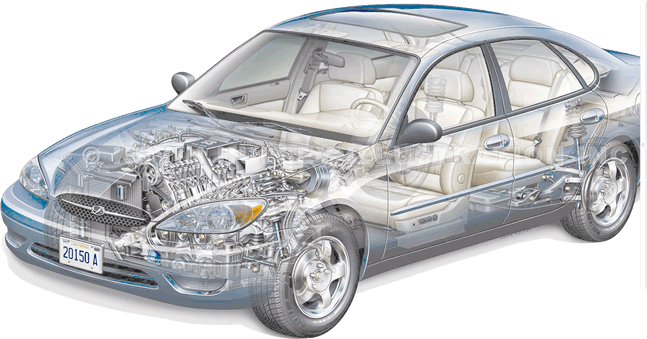
Then, we can make another distinction and point to certain objects and the way we actually categorise them. For instance, a car is made up of complex components such as chassis, engine block, axles, wheels, pistons, microchips, exhaust, seats and whole other multitude of things. 

Rather than list the individual components out each time we want to talk about it we look to the functional role of the machine and apply a concept that captures its description. The term 'car' is a convenient label that represents the machines functional role and is used in our everyday conversations as a label of convenience.

Here, we have two types of identity that we use interchangeably, and this can cause us to flit between the two while conducting first person enquiry in to the nature of what exists. What we really need to do is highlight the differences between these two ideas and look at the intuitions we have regarding the matter. 
Identity is a notoriously troublesome topic in contemporary philosophy, and aside from using a lot of algebra and tedious explanation, there is no real consensus and fractured positions on what constitutes identity. 

For our purposes though, we can simply look at our basic intuitions, and extract some key principles that we can employ to focus on LOOKING. There is no substitute for LOOKING, however, it seems to me that what gets people free is that they do the work themselves and smash the shit out of their own concepts of reality to test them for coherence.

A break down of some belief is useful, but represents only part of the way you need to go to see the fiction of 'self' in real life. For this reason we can start to flush out some of theses preconceptions we have about identity and hold them up to scrutiny in the LOOKING process, which you should ideally have started or are about to embark on. This kind of explanation will not free you and should be used as a guide on how to test a presupposition, rather than instructions for LOOKING itself.

Why is identity so troublesome?

Surely, it is simple to say “I am this body, or I am me”?

Before we can give an answer to this question we have certain presuppositions in place that must be challenged, and for this we require a thought experiment. The most famous example of identity in philosophy is known as the “Ship of Theseus” case.

In this example, the ship of Theseus was preserved over time and as each timber started to decay, it was carefully restored with a new piece. After many years, eventually none of the original parts were left as they had all been replaced, and the question we ask now is whether or not what we see before us is still the ship of Theseus?

"The ship wherein Theseus and the youth of Athens returned [from Crete] had thirty oars, and was preserved by the Athenians down even to the time of Demetrius Phalereus, for they took away the old planks as they decayed, putting in new and stronger timber in their place, insomuch that this ship became a standing example among the philosophers, for the logical question of things that grow; one side holding that the ship remained the same, and the other contending that it was not the same."
—Plutarch


Of course, it seems right to say either “it is”, or “it is not” the same ship, simply because it is contradictory to suppose it is both the Theseus and not the Theseus at the same time.

Which is the correct answer?

The answer is not apparent immediately and we must explore the consequences of each answer to see where it gets us. Firstly, if you have ever seen the television show “Only fools and horses”, you may remember the broom sketch.

'In this classic scene, Trigger claims that he's had his road sweeper's broom for 20 years. But then he adds that the broom has had 17 new heads and 14 new handles.

"How can it be the same bloody broom then?" asks Sid the café owner. Trigger produces a picture of him and his broom and asks: "what more proof do you need?" (uktv gold)'.

It is evident then, that the same principle applies to both examples and we could provide a range of cases such as a spade comprising of three parts: handle, stem, and metal plate, all the way up to a ship consisting of many parts. What is true of one of these cases is also true of the other, where all the parts have been replaced, this causes us a problem in how we attribute identity.

Bearing this in mind, with the ship of Theseus case you may have been inclined to say it was the same ship regardless of whether it was made from different material. The new Theseus, even though it has been replaced with new timbers, occupies the same spatial position and has the same name. However, this intuition seems a bit harder to hang on to when we consider the case of Trigger's broom. If we hung up the broom and swapped the head two days later, and then the handle a few days after that, can we still maintain it is the same broom so easily? We will consider this in greater depth later.

Secondly, to make things even more interesting, Thomas Hobbes' alternative thought experiment utilised the same principle as the ship of Theseus case, only this time, he suggested that if he was to collect each old part of the Theseus as it was scrapped, and then he reconstructed the Theseus out of the discarded wood, which one then would be the real Theseus?

Would it be the restored version made of new wood?
Or...
Would it be the antique built from the scraps of old wood? 


In this case it seems absurd to suggest that the one built from the scrap components is not the Theseus, while its modern counterpart is actually the real Theseus. This faces a damaging objection because how can the original parts organised in exactly the same original manner no longer be the Theseus?

If we held our intuitions steadfast against this objection and stuck to the claim the ship made from the new components was the Theseus, it's identity would consist for us in the functional role of the Theseus. We would be denying that its identity was reliant on it's actual physical matter.

If we take the opposing view and deny the new ship is still the Theseus once its components have been replaced, we also run in to difficulties. If we take our two ships constructed from new wood and the old scraps, one could commit to the idea that the ship built out of old components is the real Theseus and its modern counterpart is not the real Theseus.

Let us then suppose that the modern Theseus is a sea faring vessel and we are the captain of that ship. As we go through our life we witness each part of the ship is replaced until eventually, we have none of the original components remaining. 
It would seem absurd to suggest to us that it was not the same ship that we had sailed countless times around the world on, we could even provide the legal documentation, insurance certificates, and log book to show our claim that our ship had always been the Theseus, and this claim would have legal weight in the courts. 

In the case of the ship being built out of all the old parts, is it realistic to deny that is the Theseus though? Even though legally speaking the new ship is the Theseus, can we ignore our intuition that the same matter provides its identity?

In the instance we denied that the ship made from new wood was the Theseus, we would be denying that the functional role of the ship constituted its identity. We would be looking to the physical components themselves that manifest an objects identity.

If we were to stick with this physical matter position we face a fatal objection which consists of this challenge. At what point does the Theseus change identity? If we are willing to conjecture that the new ship stops being the Theseus at some point, then we need to be able to explain exactly when this is. In philosophy we cannot use vague concepts to gloss over our problems.

We need to provide a solid chain of reasoning to demonstrate exactly what this change consists in. So, lets try and pick a figure, perhaps when 50% of the original material has been swapped out? Why not 49%, or 25% though? 
The trouble is we cannot provide a chain of reasoning here to distinguish between any percentage and therefore any number we choose is simply arbitrary. 

Consequently no chain of reasoning is sufficient to establish an argument and we are unable to say when this change occurred. If we cannot say when or how this change occurred, then how can we claim there even was a change in the identity of the Theseus?

So, let us sum up where we are at so far. We can either point to the functional role of an object as constituting its identity, or the physical components themselves that constitute identity. 
If we choose one we must necessarily deny the other and we have discovered that if we choose either one we run in to a paradox, which means our simple preconceptions about identity are incoherent with reality. Therefore, we can point to the fact that our notion of identity is inherently flawed somewhere along the line.

From this point, we can start to point out that our life is based on these notions of identity, and as humans, we have built castles in the sand right from the very start of our lives. Hopefully, this will be illuminating for you if you have worked these ideas through and checked their integrity, however, it is not enough to show this paradox alone to dismiss our notions of identity. 
We need to be able to show further problems with our notion of identity and demonstrate how this obtains to ideas about what makes us numerically identical (one and the same thing) over time.

Before we embark further, if we imagine that an object changes its material over time, can we say it is still the same thing? This of course, depends on the position you took in the Theseus case. What relevance has the ship of Theseus to a biological organism?

Part II Here

Tuesday, 20 November 2012

Hi folks, been very busy with examinations and numerous other things so blog has taken a back seat of late. To further compound my lack of posting, I have written many half finished posts and they are in various states of being nowhere near completion! I hope normal service will be resumed soon although being buried in coursework is not helping, and I have a new post nearly finished but just to keep you going I'll plug our new prologues book which is available free to download from here.

http://www.mediafire.com/view/?mhg99y6fk2wxtoo


There are contributions from all the gang and this is particularly suited to someone who is new to the whole no-self malarky and wants a bit of background information without getting too heavy in to it. Hopefully it will pique your curiosity and inspire you to challenge your existing beliefs and you can always get assistance on the truth strike forum should you need any help in your quest to find out what exists in real life.


Enjoy :)

Sunday, 21 October 2012

This is my best attempt to explain no self and if you apply the instructions given correctly you are 100% guaranteed to see the self as a fiction*. 

(*Honesty available separately)


Metaphors are a good way of pointing out features we have never noticed before and there are plenty of good ones for no-self such as:


'There is nothing that will attain and nothing that won't attain' (Buddha)


'Produce a thought nowhere supported'
(Hui Neneg)


'Deny the self' (Jesus)


And of course the most simplistic one 'LOOK'.


However, these alone seem to be insufficient just like many others collected in the tomes of eastern philosophy and various ad hoc religions throughout the centuries. The problem with the spirituality trip is that people are mostly stuck trying to understand these things. 
They are actually pointers to guide the mind to seeing its true nature, yet some have been hijacked, Jesus is a good example of hijacked goods and there are a whole bunch of even more abstract metaphors such as 'What is the sound of one hand clapping?'

It all sounds deep and profound but really it just throws people off on a wild goose chase. What it boils down to is people really want to try and understand what these things mean, rather than actually LOOK at what they are pointing to. 
These represent a classic example of looking at the finger pointing towards the moon instead of the actual moon, to borrow another popular metaphor. One cannot see the wood for the trees quite simply, and this is really what we are dealing with when it comes down to some good old honest looking.


A metaphor can strike right through and illuminate an insight that we would previously have failed to see before. “Thunder and Sunshine” actually freed a few people just from reading its pages, it was written clearly and the metaphorical LOOK at real life has tipped a few people in to reality. 

So what is the fundamental feature of a metaphor that can be used to explain no-self? Quite simply you LOOK at what it is pointing at, just that one simple thing.


We like to think that we are the 'I' who does all the thinking and controls the actions but when challenged, people often cannot find this 'I'. They might say they cannot find it but they still hold the belief “I am me” because the thoughts says so and a belief about the matter cannot be seen through. Others still seem to cling to the hope they are some kind of higher order entity that arises as a sum of the mind and body, others still cling to the notion of a soul.

The thing is, the sum of its part is simply a concept.

A car is a handy conceptual reference to an items functional role but really the car is just a name for a collection of components bound together to realise a functional role. The car has no inherent existence, it is simply a conceptual label that captures some coarse-grained facts that are suitable for easy communication. We will focus on the fallacy of identity another time but for now we can start to LOOK at what is real.


Quite simply, 'you' are a thought 'you' don't exist in real life. It is only an illusion that you are the thinker and that you are responsible for the agency of the body. 'You' is simply a pronoun that refers to an imaginary character that the conceptual processing of the mind points to. 
Like the car, 'you' has no inherent existence above the sum of its parts. The thing is this is not difficult to see by any stretch of the imagination, it is the simplest of things to actually see this in real life. 

Lately, many people have seemed to go round in circles, we keep saying LOOK but people take this to mean LOOK for no-self. There is no self to be found because it does not exist, but what you ARE looking for, is simply the recognition of what actually exists in real life.


To characterise this, we can start to look in reality for what is true.


LOOK at a table in your room, touch it, it is an object that exists in real life.


LOOK at the computer, touch it, it is an object that exists in real life, but like our car we have attributed a convenient coarse-detailed concept to describe the intricate workings of a machine with a convenient labelling for communication. 


What is a college? Is it something real or does it have an existence above the sum of its parts, or is it really a handy conceptual reference to save us from having to describe all the buildings and all that the place entails?


LOOK at this picture:


Does Spiderman exist in real life?


Clearly not, but Spiderman exists as a fictional character. What we need to do is discern fact from fiction here.
The self is a concept that maps over our life but this is all it is. “You” is a fictional character with no inherent existence.
As absurd as it sounds, all your drama related to your self image and what people think of you is no more real than the adventures of Spiderman!  

This is not something you are required to comprehend or believe it is already true in real life. 

All it boils down to really is a belief that it is real when if you took the time to LOOK at this one particular thing, you would see directly that your identity is nothing more than a fiction. The self is no more real than the water in the mirage, the physical phenomena that support the illusion exist but in real life there is nothing there it is simply a trick of the mind.


Take a look at this duck.


OK, it is just a picture of a duck, perhaps you are trying to get this realisation of no self and you are struggling to see this. The thing is, there is no self so how can nothing see nothing? It seems counter intuitive to our experience to say there is no self but that is simply because we always think we are looking when really we are just going round in circles. 
No-self cannot be seen because there is no self quite simply. How can something that does not exist LOOK to find no-self? This realisation is not a matter of seeing no-self it is a matter of finding out the truth, what really exists in real life? Is the thought 'me' just a thought, or does it point to something that really exists?


Take a look at the picture of the duck again and now notice how it is a rabbit.

It was there all the time but you just did not notice it. Wittgenstein talked about aspect perception and noticing an aspect of a particular thing. Really, this is all that is required to see no self, it simply requires that you notice the aspect of what it really is. 

I cannot be more plain than this, it really boils down to seeing the illusory aspect of the thoughts that purport the existence of “you”. 

In this example, we have an ambiguity that switches between duck – rabbit as your apsect perception shifts between the two. The point is that you cannot 'unsee' an aspect once it has been revealed to you. The recognition of the pattern is it all it takes to see no self, just this one thing.

Of course, I used auto suggestion to get you to see the duck, having mentioned it as the title your brain was primed to focus on the duck. 
So it is with the self, we are primed to default back in tour habitual thinking patterns without actually LOOKING, but convincing ourselves that we actually have. That is the simple problem one faces if they have not seen it, they simply have not LOOKED.


Really this is how simple it all is, just looking at real life. It is not complicated by any stretch of the imagination it is simply a matter of noticing the illusional aspect of the self.

Try this one, you may want to make it full screen.  


Just a picture right?


Keep looking, can you see any characters? What about animals? Kudos if you find the Apache Indian!


Give it five minutes after you find as many as you can (there are loads). Then after short break try to look at the picture without seeing the characters and animals and you will find it is impossible because you have already seen the illusion, you cannot ever unsee it.


Appearances can be deceptive, what you really need to do is focus on what is there in real life and notice what really exists. That is all that is required to see the truth, no conceptualising, no magic tricks, no beliefs, just what is real.


What is actually there in real life? It really is as simple as that it is not complicated.

Popular Posts